

Fertility
Fertility is closely linked to overall health. Therefore, when addressing reduced fertility, we use a comprehensive approach to infertility treatment: we begin with thorough diagnostics and correct indirect fertility disorders in both the woman and the man. Only then do we start targeted and appropriate treatment.


We do everything possible so that a couple can conceive their baby naturally, without medical fertilization.

Female fertility
How does a woman change during the cycle?
Pre-ovulatory or Follicular Phase
The pre-ovulatory phase begins on the day menstruation starts. Its length varies.
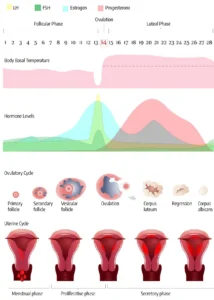
In this first phase, the woman’s body prepares for ovulation. Several eggs begin to develop in the ovaries. Throughout the growth process, the follicle that contains the egg produces a hormone called estrogen. Estrogen acts throughout the entire body, causing cyclical changes. Conditions in the body begin to change to become favourable for the survival and transport of stored sperm:
- cervical mucus becomes wetter and more lubricated, helping sperm reach the egg
- the cervix becomes softer and more open
- the uterine lining (endometrium) thickens to potentially receive a fertilised egg
The length of this first phase differs. Ovulation occurs earlier or later depending on the woman’s life circumstances.
Ovulation timing is influenced by:
- stress
- emotions
- medications
- season
- nutrition and health
- changes in sleep pattern
- and other daily routine changes
This variation in the phase determines the length of the woman’s cycle (see the image below).
Ovulation
Ovulation occurs after estrogen reaches its peak level. The pituitary gland releases luteinizing hormone, which triggers ovulation. The follicle then opens and releases the egg, which is captured by the fimbriae of the fallopian tube and guided through it.
After ovulation, the presence or absence of sperm determines the fate of the released egg. The egg lives no more than 24 hours (on average 8–12 hours). Sometimes, a second ovulation can occur a few hours after the first; however, both eggs will disappear within 24 hours if they are not fertilized. If the eggs are fertilized by separate sperm cells, non-identical twins may form.
During ovulation:
- cervical mucus becomes clear, wet, slippery
- the cervix rises and becomes soft
Post-ovulatory or Luteal Phase
The post-ovulatory phase begins after ovulation and ends on the last day of the cycle. After ovulation, the follicle transforms into the corpus luteum, which releases the hormone progesterone into the woman’s bloodstream. Under the influence of progesterone, a second ovulation is no longer possible, and the infertile phase begins.
During this time, the body prepares to protect a potentially fertilized egg. The cervix becomes firmer, its opening smaller, and cervical mucus thickens, forming a mucus plug that protects the uterus from external elements.
Progesterone also causes the uterine endometrium to thicken, where a fertilized egg may implant if conception occurs. Under the influence of progesterone:
- basal body temperature (BBT) rises
- the cervix lowers and becomes firm
- mucus production decreases
- a feeling of dryness appears
Over the next 12 to 16 days, two scenarios are possible:
- If fertilization and implantation occur, progesterone levels increase and play a key role in maintaining the pregnancy. BBT remains elevated throughout pregnancy.
- If pregnancy does not occur, progesterone release slows down as the corpus luteum degrades; it is shed together with the endometrial lining during the next menstruation.
BBT drops again at the end of the cycle.
Male Fertility
A full spermatogenesis cycle (the formation and maturation of new sperm cells) takes approximately three months. For this reason, sperm quality is not constant in most cases — it changes according to the man’s lifestyle and external factors. Sperm quality is affected by alcohol use, excessive caffeine and energy-drink consumption, smoking, high stress and sleepless nights, excess weight, medication use, and exposure to chemicals.
Chemicals influence hormone production — that is, testosterone production in men. The problem with chemical exposure is present not only in large cities or industrial settings where various substances are used in manufacturing, but also, for example, BPA, which is often found in plastic bottles or food containers. BPA acts as an endocrine disruptor, affecting testosterone levels and therefore the number of sperm produced. Sperm quality is closely linked to what is happening in the overall body. Studies show that men with low sperm quality have a higher likelihood of experiencing other health problems such as diabetes, cancer, and cardiovascular diseases.
Of course, reduced sperm quality can also be temporary, for example while taking certain medications, or simply after recovering from a flu infection.
In our online store, it is possible to rent the Ferterex photobiomodulation therapy device for men to improve sperm quality — a product created and patented in Latvia.
The Ferterex innovation is similar to laser therapy and uses monochromatic light wavelengths to stimulate energy levels in sperm cells. This device improves sperm quality through photobiomodulation (LLLT) technology.
Ferterex not only improves sperm quality but also increases sexual desire (libido) and reduces erectile difficulties caused by internal and external factors such as lifestyle, diet, stress, and various health conditions. Ferterex increases testosterone levels, improves sperm motility, and increases the number of normal sperm cells.
The FertereX device is patented in Latvia and designed to be comfortable and safe for men to use at home — only 10 minutes, 2–3 times per week, for a period of 2–3 months.
Infertility treatment
One should start thinking about infertility if pregnancy does not occur within one year,
despite having regular sexual intercourse (1–3 times per week) without contraception.
There are various causes of infertility, which may be related to the woman, the man, or both partners.
Read more about the causes of infertility, the methods we use in infertility treatment,
and how this process works in practice at “Ģimenes sirds” here.
In cases of reduced fertility
How does infertility consultation work at “Ģimenes Sirds”?
You must book (reserve a time) for the initial infertility diagnostics and treatment visit and make the consultation payment through the link you will receive after booking.
After payment, a fertility questionnaire will be sent to the email address you provided. It must be completed by both of you no later than three days before the scheduled visit so that we have enough time to process your data.
This visit usually takes place remotely (after agreeing with you on the format — WhatsApp, Google Meet, or Zoom). During the consultation, an individual diagnostic plan — and possibly also a treatment plan — is created, the timing and type of the next visits are arranged, and further recommendations are provided.
What is a fertility management consultation for couples experiencing reduced fertility?
This consultation is indicated for couples who are assigned to it during the initial infertility diagnostics and treatment visit, or for couples who choose it as their first visit in order to understand whether there is a fertility problem or not.
Fertility-management consultations for couples with reduced fertility include an initial consultation and at least two follow-up consultations in order to observe 2–3 menstrual cycles and identify possible issues.
During the initial consultation, the couple is introduced to the basics of the woman’s menstrual cycle and the biomarkers of cycle-related hormone activity, so that cycle observation and identification of potential problems can be performed.
The most suitable cycle-tracking system for the couple is chosen, and introductory instructions on how to perform cycle observations are provided.
In the following consultations, the cycle observations made since the previous visit are reviewed, and correct charting of the observations is clarified.
Possible ovulation is evaluated, as well as how the woman’s hormonal fluctuations in the cycle can be identified based on the recorded observations, and how to determine the potential time of ovulation.
Recommendations are given regarding how and when to perform hormonal measurements, if needed.
If fertility disorders are identified, the couple is then referred to an infertility diagnostics and treatment visit.
Family planning
Fertility management is not only a tool for diagnosing fertility problems, but also a method of healthy self-monitoring — that is, becoming aware of the woman’s fertile and infertile periods, understanding the phases of the menstrual cycle, so that the couple or the woman can adapt this knowledge to their needs: to better understand and learn their own physiology and/or to plan a pregnancy and/or to postpone conception.
Fertility management consultation for family planning
Anyone — any woman or couple — who wants to understand their body better and/or plan their family can choose this option.
The couple or woman is introduced to the basics of the menstrual cycle and the biomarkers of hormonal activity, so they can observe the cycle and independently identify fertile and infertile periods within the cycle.
The most suitable cycle-tracking system for the couple is selected, and instructions for beginning observations are provided.
During the following consultations, the cycle observations made since the previous visit are reviewed, correct charting is clarified, and possible ovulation is assessed.
For successful learning of fertility management, at least 2–3 consultations are needed. Consultations can also take place remotely.
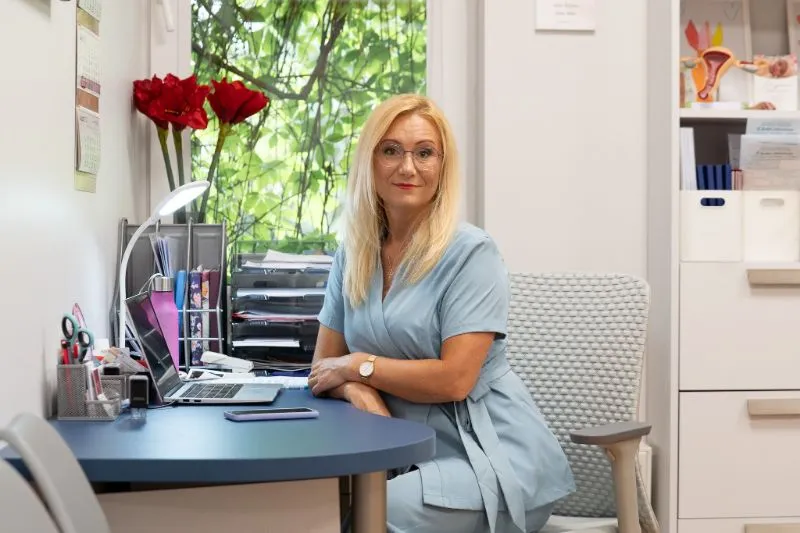
Aiga Rotberga
Gynecologist and Obstetrician, Obstetric and gynecological ultrasonography specialist
- Provides fertility management consultations for couples with reduced fertility, develops an individualized treatment plan, and ensures ongoing treatment monitoring.
- Performs various gynecological endoscopic procedures (laparoscopy and hysteroscopy) for the diagnosis and treatment of infertility.

Baiba Stikute
Midwife, Fertility management consultant
- Certified midwife with 15 years of experience
- Fertility management consultant, offering:
- Menstrual cycle consultations for adolescents and young women
- Consultations on cycle tracking, including systems and apps tailored to the preferences and priorities of the woman or couple
- Family planning consultations – for couples planning to conceive and for couples wishing to postpone pregnancy