

Office Hysteroscopy
What is hysteroscopy?
Hysteroscopy is a minimally invasive gynecological diagnostic and treatment method that allows direct visualization of the inner surface of the uterine cavity using an optical instrument called a hysteroscope. The procedure is performed through the vagina and the cervical canal, without surgical incisions.
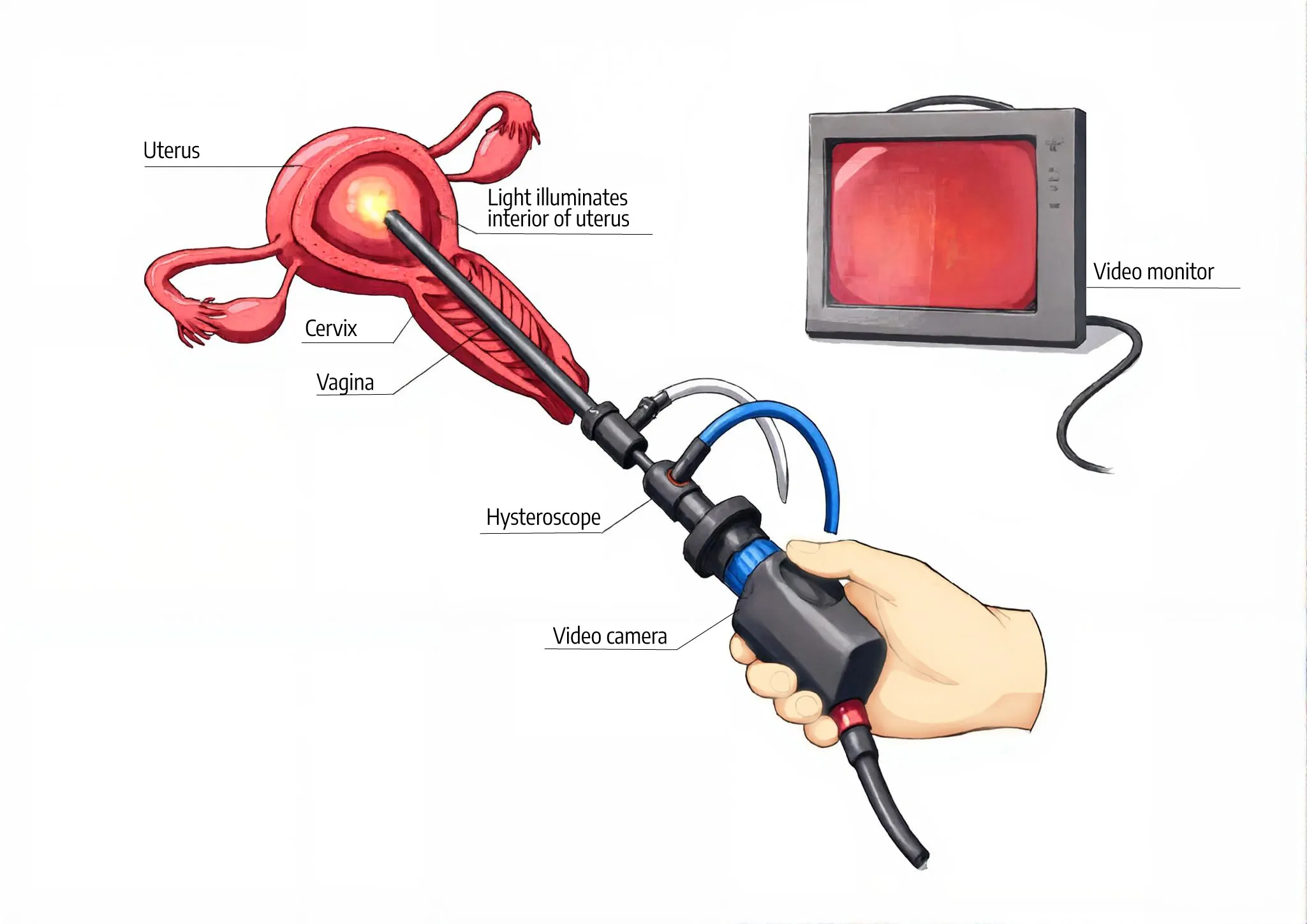
How is office hysteroscopy performed?
Office hysteroscopy is performed without anesthesia in an outpatient setting, in a gynecologist’s office. Anesthesia is not necessary because the optical instrument used is very small in diameter (3.5–4.5 mm). For this reason, it is called office hysteroscopy.
During the procedure, a hysteroscope is inserted through the cervical canal into the uterine cavity. The hysteroscope is connected to a video system, and the uterine cavity is expanded with physiological saline solution, allowing high-resolution visualization.
This method allows doctors to detect various uterine cavity pathologies, identify causes of infertility within the uterine cavity, take an endometrial biopsy, and clarify diagnoses when suspicious findings appear on ultrasound. It can also correct small uterine cavity defects, such as removing a polyp, adhesions, or a uterine septum.
Important to know:
-
The procedure lasts approximately 5–15 minutes.
-
To ensure the examination is as accurate as possible, it is usually performed at the beginning of the menstrual cycle — immediately after menstruation ends (cycle days 5–9).
-
If necessary, a pain reliever may be taken shortly before the procedure.
-
After the procedure, there may sometimes be slight spotting or mild pulling sensations in the lower abdomen, which usually resolve on their own.
-
Normal daily activities can be resumed without any restrictions.

Advantages of office hysteroscopy
-
A painless procedure that can be performed without anesthesia — anesthesia is not necessary because mechanical dilation of the cervix is not performed, which is usually the main cause of pain.
-
Work capacity is not limited — it is possible to return to normal daily activities immediately after the procedure.
-
A gentle method without trauma or damage to the cervix — this factor is particularly important for women of reproductive age.
Office hysteroscopy is ideally suited for:
-
To remove small endometrial polyps (up to 10 mm)
-
To divide uterine cavity adhesions
-
To take a targeted biopsy under direct visual control, for example after treatment of endometritis or endometrial hyperplasia
-
In infertility diagnostics — this method is considered the “gold standard”, as there are pathologies that cannot be visualized by ultrasound; it also allows targeted biopsy to rule out chronic endometritis
-
In cases of congenital anomalies, it is one of the best methods to evaluate the pathology and choose the most appropriate surgical treatment
-
In more complex uterine fibroids, as a diagnostic method to determine the most suitable treatment
-
For removal of a foreign body (for example, an intrauterine device)
Office hysteroscopy is not suitable for:
-
For resection of uterine fibroid nodules
-
If uterine polyps are larger than 10 mm
-
For correction of a cesarean section scar “niche”
-
In cases of retained products of conception
-
In uterine cavity anomalies where myometrial resection is required
In these cases, hysteroresctoscopy under intravenous anesthesia will be required. (These procedures are performed by gynecologist Aiga Rotberga at Cēsis Clinic.)